Common questions: a guide to learning NVC
Thinking of learning NVC? Or perhaps you’ve already started on the journey. What to expect, and how to advance.
In this guide, I’ve compiled some answers to common questions people ask about learning NVC. How long does it take to learn? How do you actually practise it? What can help you improve? And how is it different from other practices? Read on for more details.
How long does it take to learn NVC?
This is a question we’re often asked by people considering coming to one of our workshops. And it’s a fair question! I know it’s something I consider when I want to learn any new skill - what kind of commitment can I expect? How long will it be before I start to notice any progress?
The short answer is that there is no short answer! How long does it take to learn NVC? Anything from 10 minutes to 50 years. NVC is not so much something you learn as something you become. You can learn what it is intellectually, but the depth and nuance and self-understanding develop and deepen over time, and it can take a lifetime to master.
Asking how long it takes to learn NVC is a bit like asking how long it takes to learn meditation, or to play a musical instrument. It’s not something you learn how to do in theory, and then you know how to do it. It’s more something you deepen through doing. In this sense it’s more of a practice than a set of tools that you can pick up and apply. Although paradoxically, it’s also a set of tools that you can pick up and apply! And even the most rudimentary understanding of NVC can make a real difference in your relationships.
A more useful question might be: how much time and commitment do you want to give to NVC? It can be rewarding at any level. Keep reading, and I’ll try to give some details of what to expect from NVC with varying levels of commitment.
First a (very) brief intro. If you’re already familiar with the basics you can skip ahead a couple of paragraphs.
Learning Nonviolent Communication: the quick version
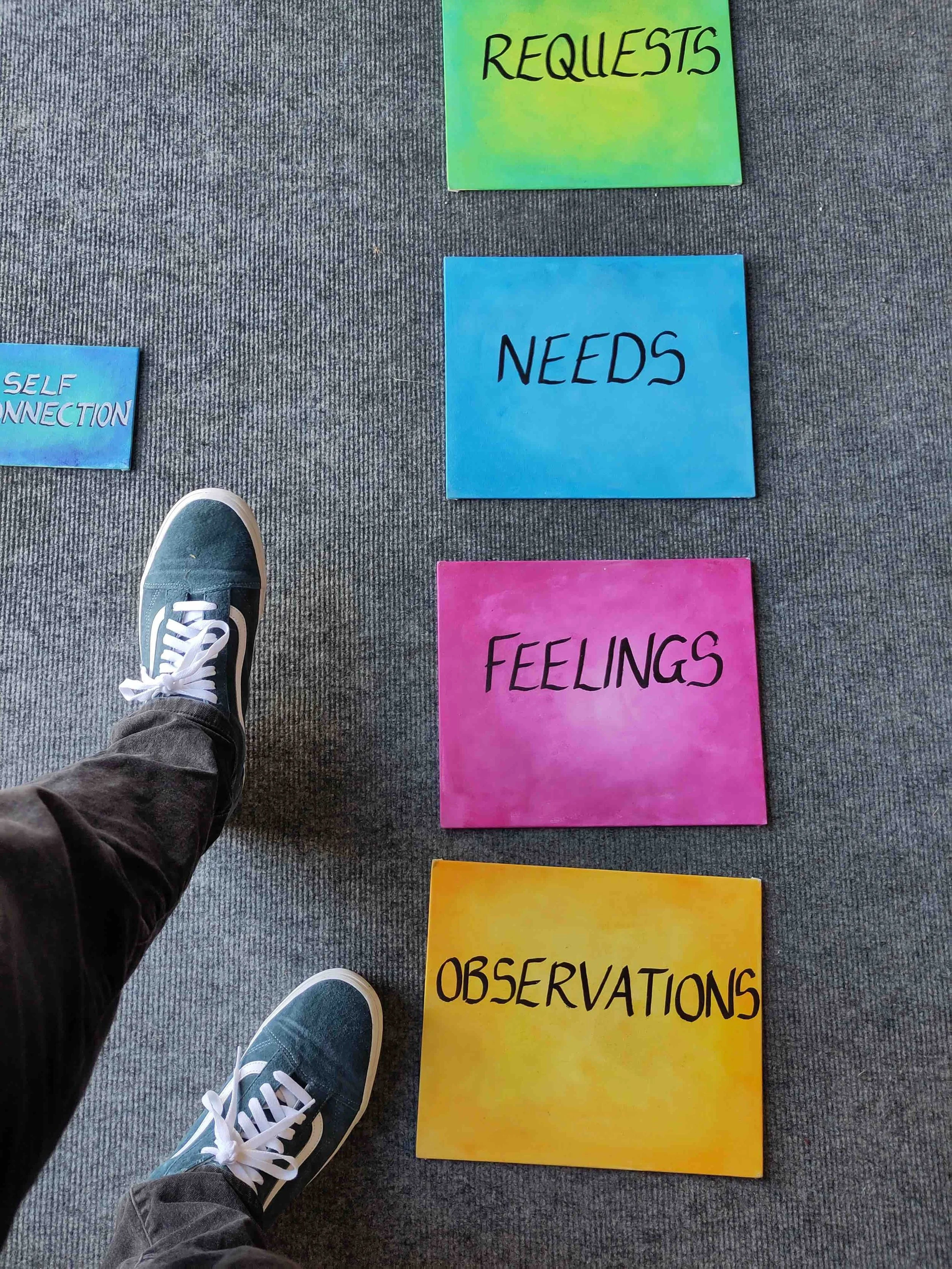
In its most basic form, NVC is a set of four steps: observations, feelings, needs, and requests, and three modes: connecting to self, receiving others, and expressing honestly. And one overarching rule: if it’s not rooted in the intention to connect, then it’s not NVC.
In classic NVC, we formulate our thoughts using the phrase ‘When I see/hear…(insert observation) I feel… (what comes up in you) because I need…(why it matters to you). Would you be willing to….(inset request). We hold these different steps in our awareness while moving between the three modes. If we stick to this basic template (adjusting it so that we express ourselves in a way that sounds more natural and less formulaic!) then our words are more likely to land the way we intend them, and we’re more likely to get our needs met.
Simple! And yet incredibly complex. We can explain the basics in a couple of paragraphs, as I’ve done here. And even with this much knowledge, we can try it out straightaway - and we can already start to see results.*
Of course, there’s a lot more to it than that, and there are nuances within all these steps. To get a more thorough understanding, I’d really recommend attending a workshop, where you’ll start diving into some of these in more detail (when is a feeling not a feeling? When is a need not a need? What’s the difference between an observation and an evaluation? What gets in the way of connection even when we’re trying to apply these steps?) Our foundation trainings are a good example of this type of workshop.
*Disclaimer: I’d be wary of expecting too much at this stage. Like any new language when we first start trying to speak it we tend to sound clunky and unnatural, and the people we’re talking to are likely to perceive that we’re ‘doing something weird’, rather than communicating authentically.
NVC and muscle memory: How do you integrate it? How long does it take?
It’s common to feel very inspired when we first encounter NVC, and determined to put it into practice, but it can be hard to keep ourselves accountable when we slip back into our daily lives! And it can also be challenging to move beyond understanding it in theory to actually living with NVC.

Establishing some sort of regular practice is key.
This could mean taking up journalling: for example, making a note of things that happen during the day, and translating them into observations, feelings, needs, and requests. Or paying attention to things you feel triggered by, and working through NVC processes in your journal.
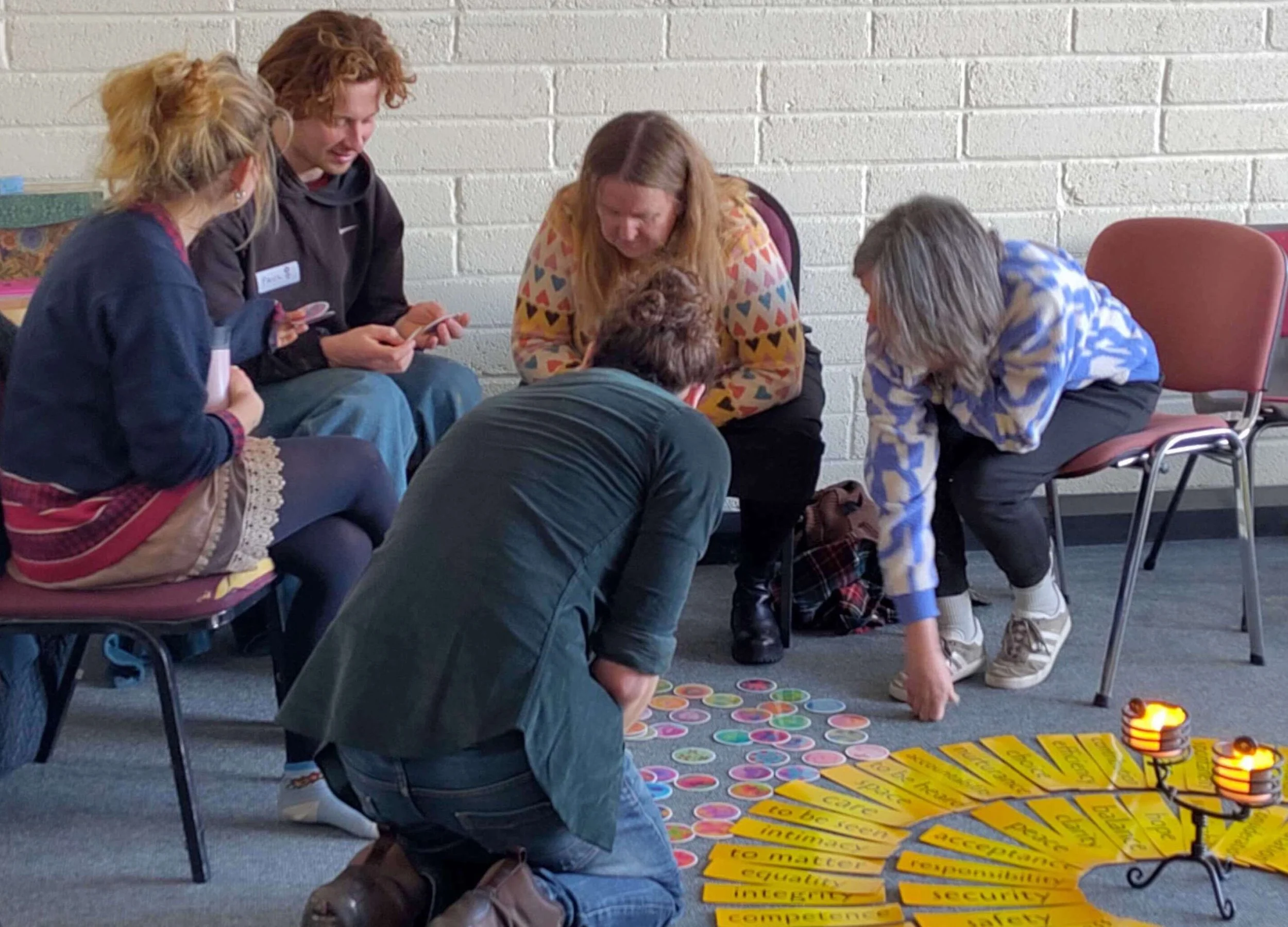
Another option is to join (or start) a practise group. Having at least one other person to practise with really helps with integration, so if you can attend a workshop with a friend or partner, then do, because you’ll then have a shared understanding, and an automatic practice partner. Another option is to keep in touch with someone you met during a workshop, and arrange to meet up regularly (in person or online) to practise and for support and accountability.
This system of ‘empathy buddies’ is one of the cornerstones of NVC community, and even advanced practitioners and NVC trainers still meet up regularly with their empathy buddies for mutual support and empathy exchanges.
As an aside, I’m currently thinking of setting up a group of practice buddies throughout Ireland who can work together and support each other. If this is something you’re interested in please get in touch, as whether or not I do this depends on how much interest there is from people in my networks.
How long it takes to integrate really does depend on you, how much time you put into practising, and (very importantly) how much interaction you have with others who are also practising.
I’d also add that it’s not really a linear journey. We can be making great progress with our NVC practice, then we get triggered by something unexpected, and all our old behaviour patterns flare up again. That doesn’t mean we’re straight back to square one, though. One episode of snapping at the kids doesn’t mean we’ve failed and we’re no good at NVC. It’s more a case of something to reflect on, and deepen our understanding of what’s going on for us that stimulates this sort of reaction. It’s an ongoing journey of becoming more aware, and less reactive, over time.
What does NVC practice actually look like?
The first stages of NVC practice involves really familiarising ourselves with the basic steps: observations, feelings, needs and requests. Not just on a theoretical level, so we understand them as concepts. On an experiential level. We analyse our day to day lives, our thought processes, our behaviours, and explore what needs are alive in any given moment, and we get more deeply in touch with our innermost motivations and values. We learn to recognise when we’re making evaluations, and practise being clearer with our observations. We tune into our bodies and notice what we’re feeling. We learn how to ask for what we want in ways that are more likely to land the way we intended them.
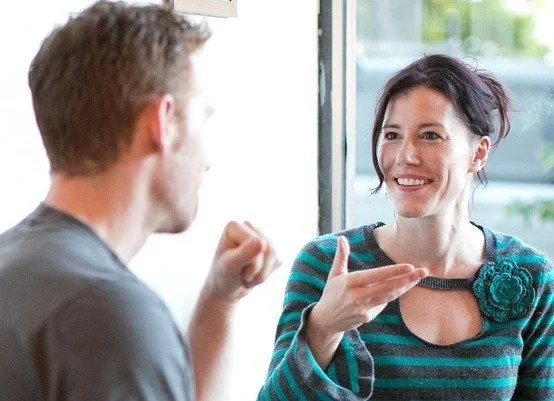
Another thing we practise is our listening skills.
We practise empathic presence, keeping our attention on the person who is speaking, and only switching to expressing about ourselves when we consciously choose to do so. We try to pay attention to what really matters to the other person, and hold back from responding in ways that get in the way of connection.
This necessarily involves becoming more aware of our habitual ways of thinking and communicating. We begin to track any tendencies we have to express ourselves in ways more likely to stimulate defensiveness in others. Sometimes this means resisting an urge to react in a particular way, and making choices around acting in integrity with this new way of connecting with others.
We also work at translating our judgements about other people. As we work through NVC processes, we often experience profound shifts in our thinking about other people in our lives. This often leaves us feeling far more tolerant and compassionate towards people who we previously found challenging, and far more understanding of their motivations.
We also work intentionally on defusing our triggers. We can work consciously with them each time they come up, so over time we become a little less judgemental, a bit more self aware, compassionate, understanding of others, and we develop more choice around how we react.
There are lots of different processes that we use in various situations: some for navigating strong emotions like shame or anger, or for creating less discomfort when we hear a specific trigger phrase. There are others to use when we’re struggling to make a decision. Some processes support us when we feel hurt by someone else’s behaviour, others support us to come to terms with having done something we regret, and help us resolve to act differently in future. There are also processes for repairing connection with others, and for things like experiencing gratitude on a deeper level.
NVC practice changes at different times, depending on who we are, what we’re trying to learn, and what direction we’re coming from in our journey, and things like the different cultures we were raised in (both on a wider social level and within different families of origin). We all have our different learning edges (things that we find more difficult than others), and these will be different for different people. Some of us struggle to connect with our feelings. Others have a hard time asking for what they want. Some people want to be more assertive and speak up for their needs. Other people might be learning to hold their tongues.
I already have a mindfulness practice. Is NVC different?
If you’re already familiar with inner work, then NVC can blend seamlessly with your existing self-awareness practice. It will most likely provide you with new insights and can open up whole new avenues to explore. There will likely be quite a few aha moments, and it can support more of your relationships to deepen and become more fulfilling.
It can also really help refine our sense-making, help us understand why we really do the things we do, and why others sometimes act in ways that are so frustratingly alien! It can create a lot more inner space around triggers so we build more awareness, and develop more capacity to make conscious choices before we react. And it can provide very practical tools that change things you might not have even realised were changeable (you know those things that you really don’t like but always just assumed that you have to live with? Maybe you haven’t even noticed them because you’ve been putting up with them for so long - but they’re probably there!)
NVC is compatible with a lot of other practices that you may have come across: mindfulness, somatic work, focusing, internal family systems, and authentic relating, to name but a few. I do think NVC provides something entirely new, though, a whole new way of understanding ourselves, and perceiving and relating to others.
To me the potential of NVC is massive: far more than just another modality, I tend of think of it as a paradigm shift. Stepping into NVC consciousness can be life-changing on a personal and interpersonal level, and if it was applied on a societal level, I truly believe it could completely transform a lot of the bigger issues that plague our species, from inequality and social justice to prejudice, polarisation, and even war .
For more about NVC as a paradigm shift read this post.
Want to read more? Check out some of our other blog posts:


More than a tool to improve our communication, NVC is a paradigm shift, moving us beyond right and wrong thinking.